What Is a Service Lane Technology System (SLT)?
Industry Guide • Fixed Operations
A service lane technology system, or SLT, is the suite of digital tools that manages a dealership’s service department from the moment a customer books an appointment to the moment they pay and drive away. It’s the operational backbone of fixed ops. If your service department is still relying on paper write-ups, phone-tag with customers, or disconnected software that doesn’t talk to your DMS, you’re likely leaving efficiency and revenue on the table.
What Does a Service Lane Technology System Actually Include?
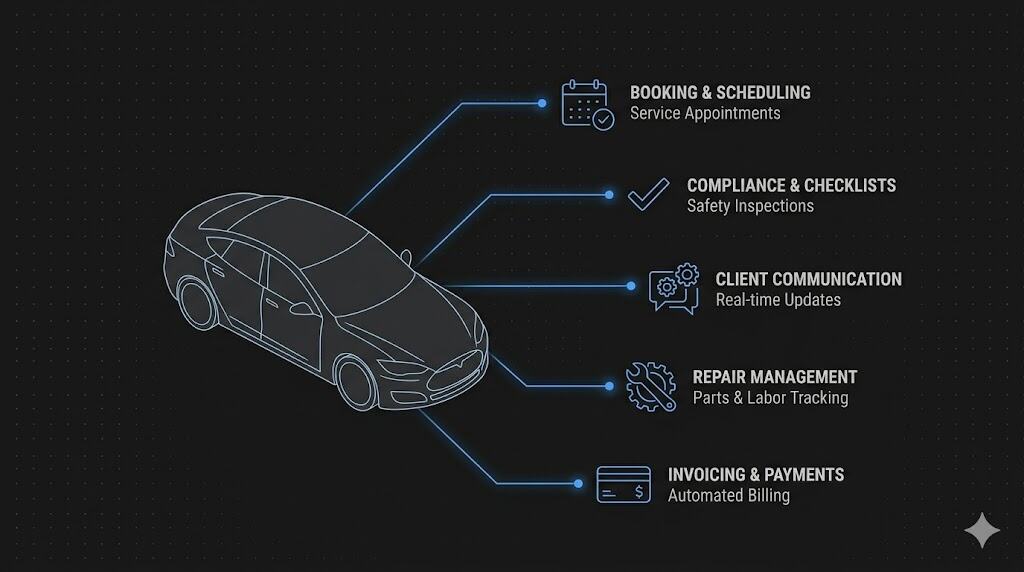
SLT is not a single tool. It’s a connected platform that covers the full service workflow. As Kimoby describes it, an SLT manages service department operations from the moment a vehicle appointment is booked through to final payment. When those tools work together, the whole service lane runs faster.
Core components typically include:
Online Scheduling
Customers book appointments through the dealership’s website, with capacity managed by the system. No phone calls, no double-booking.
Digital Check-In and Write-Up
Service advisors capture vehicle information, mileage, and customer concerns on a tablet or mobile device — pre-loaded from the DMS so nothing gets re-entered.
Multi-Point Inspection (MPI)
Technicians document findings digitally, often with photos or video sent directly to the customer. Visual evidence builds trust and drives higher approval rates.
Digital Estimates and Approvals
Customers review recommended services and approve or decline work via text or a customer portal — no phone tag, faster turnaround on repair orders.
Two-Way Communication
Texting and automated updates keep customers informed throughout the visit, reducing inbound status calls and freeing advisors to focus on the lane.
Mobile Payments
Customers pay before pickup, reducing checkout time and lobby congestion at the end of the day.
DMS Integration
All data flows bidirectionally with the dealer management system, eliminating duplicate entry and keeping every department on the same record.
How Does SLT Connect to the DMS?
This is where the real value sits. A disconnected SLT creates exactly the problems it’s supposed to solve: duplicate data entry, missed repair orders, and information gaps between advisors and technicians.
According to Dealertrack, when fixed operations software shares data bidirectionally with the DMS, dealerships eliminate redundant entry and the disconnected systems that hurt performance. Good SLT platforms offer certified, real-time integrations with major DMS providers including CDK, Reynolds and Reynolds, Dealertrack, and Tekion.
As Dealerlogix notes, a bi-directional DMS integration reduces repetitive clicks, manual steps, and duplicate data entry across the service department. For a deeper look at how that integration layer works, see How Unified APIs Work in Practice and How to Integrate with an Automotive API.
Why Do OEMs Require Certified SLT Providers?
Many manufacturers now mandate that their franchise dealers use an approved SLT provider. This is not arbitrary. OEMs use customer satisfaction index (CSI) scores to determine dealer incentives, vehicle allocation, and bonus structures.
According to JMA Group, low CSI scores don’t just reflect poor customer satisfaction — they directly reduce revenue through lower bonuses, incentives, and restricted vehicle allocation.
As Dealer-FX explains, certified SLT providers must meet rigorous standards to ensure critical features and seamless integrations are available — covering scheduling, repair order write-ups, digital inspections, and mobile payments.
If your dealership is affiliated with Kia, Hyundai, GM, Toyota, or other major OEMs, confirm whether you’re enrolled in their certified SLT program. Non-compliance can affect your standing with the manufacturer.
What Problems Does SLT Solve?
The service lane is often the highest-traffic department in a dealership. It’s also where inefficiencies compound quickly.
Long Customer Wait Times
Digital check-in and pre-loaded vehicle data speed up the write-up process significantly. Customers who used to wait 20 minutes at the counter move through in a fraction of that time.
Low Repair Order Approval Rates
Video MPI shows customers exactly what needs to be fixed, which builds trust and increases approvals. A written description of a worn brake pad is easy to decline. A video of it is harder to ignore.
Slow Payment and Checkout
Mobile payment options let customers pay before pickup, cutting lobby wait times and reducing end-of-day bottlenecks at the cashier.
Poor Internal Communication
Advisors, technicians, and parts staff share a live workflow rather than relying on phone calls and paper. According to Kimoby, automated reminders, updates, and payment links can cut inbound calls significantly, freeing advisors to focus on selling rather than answering status questions.
What’s the Difference Between SLT and a DMS?
This is a common point of confusion. Your DMS is the core operating system of your dealership — it handles accounting, payroll, inventory, finance, and service record-keeping. SLT sits on top of the DMS and focuses specifically on the customer-facing and workflow-facing experience in the service department.
Think of the DMS as the database and the SLT as the interface your team and customers actually interact with. As JMA Group puts it, technology platforms use the data flowing through dealership systems to identify revenue opportunities, improve workflows, and create better customer experiences. The DMS holds that data. The SLT puts it to work.
They need each other. An SLT without DMS integration is just another disconnected tool. A DMS without SLT leaves your service department operating manually. For more on how these systems interact, see Automotive Unified API Pros and Cons.
Is SLT Only for Franchise Dealerships?
No. The term “certified SLT” is specific to franchise OEM programs, but the underlying technology applies to any shop running a service department. Independent dealerships, used-car operations, and multi-point service centers all benefit from the same core capabilities: online scheduling, digital inspections, customer communication, and DMS-connected workflows.
As Dealerlogix notes, service lane technology supports dealerships in increasing efficiency, profitability, and customer retention across the full service workflow — from scheduling to vehicle delivery. The scale may differ, but the operational logic is the same.
FAQ
What does SLT stand for in automotive?
SLT stands for Service Lane Technology. It refers to the digital tools and software platforms that manage dealership service department operations.
What is the difference between SLT and fixed ops software?
They often refer to the same category of tools. “Fixed ops software” is the broader term for technology used in a dealership’s service and parts departments. SLT is a specific subset focused on the customer-facing service workflow.
Does SLT work with all DMS platforms?
Most major SLT providers offer certified integrations with leading DMS systems including CDK, Reynolds and Reynolds, Dealertrack, and Tekion. Integration quality varies by provider, so confirming bi-directional, real-time data sync is important before selecting a platform.
Why do some OEMs require specific SLT providers?
OEMs set SLT requirements to protect brand standards and customer experience consistency across their dealer network. CSI scores — which affect dealer incentives and vehicle allocation — are directly tied to service department performance.
Can smaller dealerships or independent shops use SLT?
Yes. While OEM certification programs are specific to franchise dealers, the core SLT tools — scheduling, digital MPI, communication, and payment — are available to independent operations as well.
Bottom Line
A service lane technology system connects every stage of the dealership service experience into one coordinated workflow. It reduces manual work, speeds up approvals and checkout, and keeps customer data in sync with your DMS. For dealerships evaluating or upgrading their fixed ops stack, SLT is not optional infrastructure — it’s the layer that determines how well your service department actually runs.
Ready to see how AutoUnify fits into your dealership’s tech stack? Book a demo.